Why You Can't Access Your Best Self During Conflict
This article is adapted from my Substack essay, State Determines Everything, where I explore the relationship between nervous system state, capacity, and connection.
Leaving Yourself Under Relational Tension
Have you ever wondered why it's so hard to be the person you intended to be when conflict, stress, or pressure enters the room?
One moment you're calm, patient, and grounded.
The next, you're saying things you never meant to say, reacting in ways that surprise you, or shutting down completely.
Most people assume this is a communication problem.
I don't think it is.
I think it's a state problem.
The Person You Intended to Be Disappears
The version of you that exists during a quiet morning coffee doesn't always exist during a disagreement with your partner.
There's the version of you that has reflected, prepared, and knows exactly how you want to show up.
Patient.
Connected.
Clear.
Grounded.
Loving.
You know what you want to say.
You know how you hope you'll respond.
You know the kind of partner you want to be.
Then pressure rises.
Emotion enters.
Something doesn't go the way you expected.
And suddenly...
You hardly recognize yourself.
I call this State Collapse: the moment your regulated self goes offline and a narrower version of you takes over.
Your tone changes.
Your body tightens.
Your reactions get faster.
You interrupt instead of listening.
Defend instead of staying open.
Withdraw instead of connecting.
Afterward comes the familiar question:
"Why did I do that?"
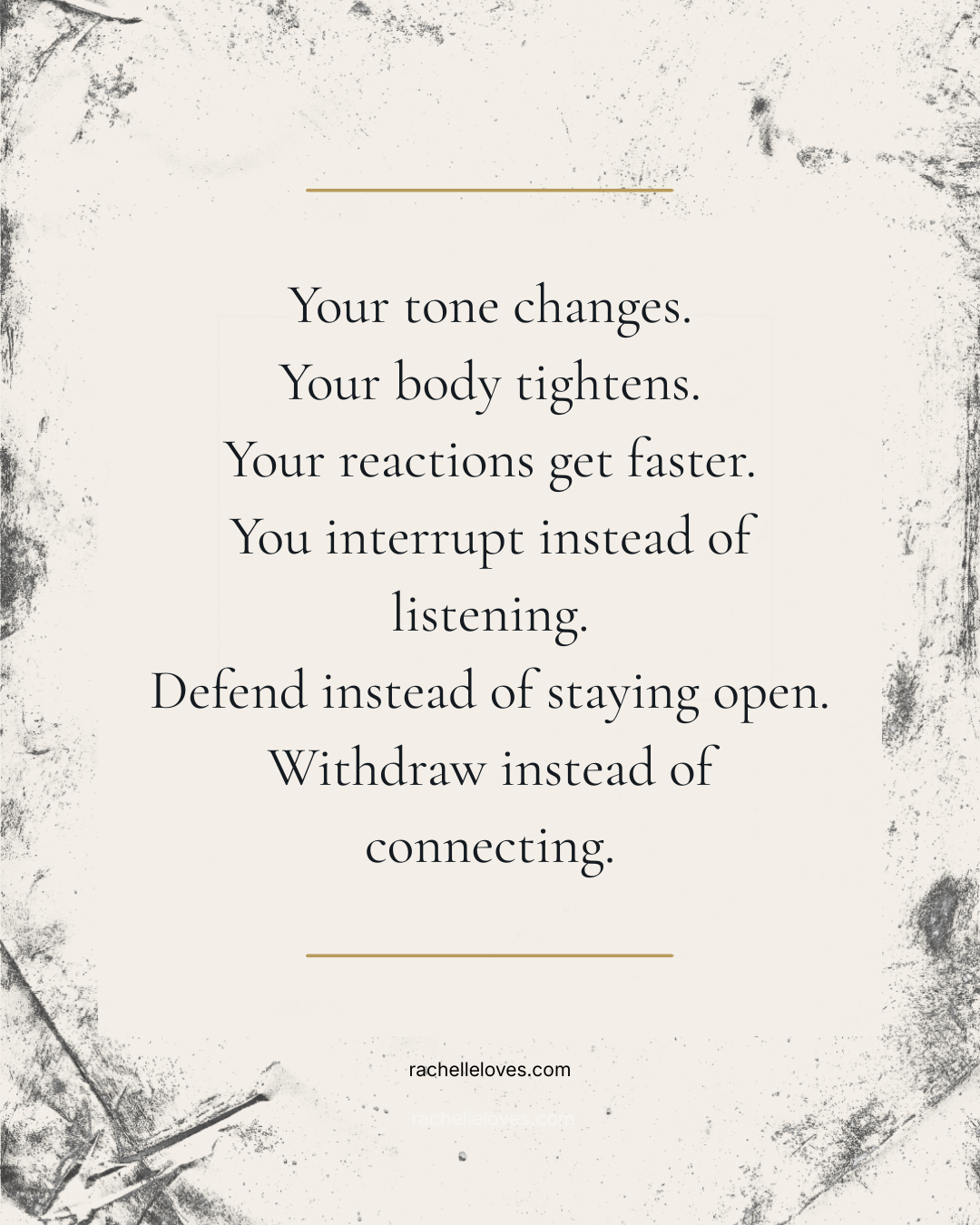
Perspective Narrows with Relational Conflict and Tension
But I've become more interested in a different question:
Why does access to the version of ourselves we trust the most disappear the moment we need it most?
Before We Talk About State, We Have to Talk About Capacity
In my previous Field Note, Why Relationships Breakdown Under Pressure, I explored the idea that relationship conflict isn't created by pressure. Pressure simply reveals the capacity we already have to stay present.
Read it here:Why Relationships Break Down Under Pressure
This article takes the next step.
If capacity is what allows us to remain connected under pressure...
What determines whether that capacity is available in the first place?
The answer, I've come to believe, is state.
State Is Your Operating System
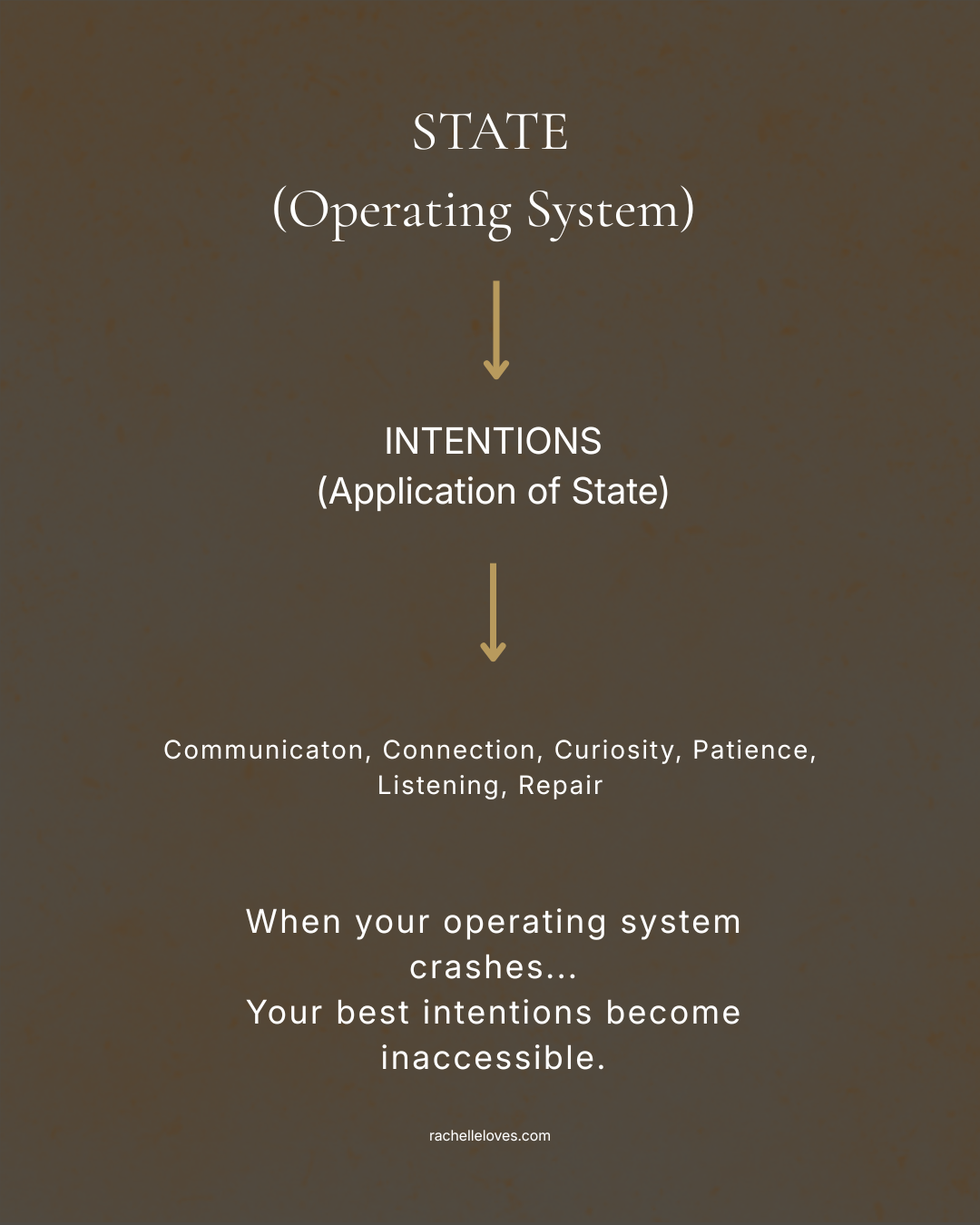
State Operating System Infographic
Think of it this way.
Your state is the operating system.
Your intentions are the apps.
You can download all the communication tools, relationship books, and conflict strategies you want.
But if the operating system is crashing...
None of them open.
They're still there.
You just can't access them.
For years, I thought I needed better communication skills.
But communication wasn't what I lacked.
I lacked access.
Access to the version of myself that already knew how to stay.
That realization changed everything.
You Don't Rise to Your Intentions
Here's the distinction that has become foundational in my work:
You don't rise to your intentions.
You fall to your state.
This isn't just another mindset shift you'll underline in a book and forget a few days later.
It's one of the most reliable predictors of whether you'll become the person you intended to be...
or the person your nervous system decided you needed to become.
Your state determines:
What you notice
What you feel
What you interpret
What you're capable of accessing
When your nervous system is regulated, the world feels different.
There's space.
Curiosity.
Choice.
You can listen.
You can soften.
You can stay.
But when your nervous system becomes activated...
Everything narrows.
Neutral becomes threatening.
Feedback feels like criticism.
Disconnection feels like danger.
The values you care about most become temporarily inaccessible.
Not because they've disappeared.
Because your state has changed your reality.
Why This Matters in Relationships
You can see this most clearly in intimate relationships.
You intend to listen.
Instead, you interrupt.
You intend to connect.
Instead, you defend.
You intend to soften.
Instead, you close.
Same person.
Different state.
This is why so many couples say:
"We know what we're supposed to do... we just couldn't do it in the moment."
Exactly.
The issue isn't a lack of knowledge.
It's a lack of access.
Why This Matters in Sport
I see the same pattern every time I step onto a pickleball or volleyball court.
You've practiced.
You've executed this shot hundreds of times.
You know how to communicate with your partner.
Then the score tightens.
Pressure rises.
Your timing changes.
Communication breaks down.
Frustration builds.
Nothing about your skill disappeared.
Your state changed your performance.
The court simply revealed it.
High-Intensity People Don't Need Less Intensity
If you've spent your life being told you're too emotional, too reactive, or too intense...
This matters even more.
You may have spent years trying to become smaller.
Calmer.
Less expressive.
Less sensitive.
But I don't believe intensity is the issue.
You don't need to become less intense.
You need to become more capacious.
You feel deeply.
You care deeply.
You want truth, connection, and aliveness.
Without the capacity to hold that much energy, intensity often turns into:
Reactivity
Overwhelm
Defensiveness
Disconnection
Not because you're "too much."
Because no one taught you how to stay with that much energy moving through your body.
The Work Isn't Better Behavior
Most relationship advice tries to change behavior.
Say the right thing.
Do the right thing.
Control the moment.
But behavior is downstream.
If your state is unstable...
Your behavior will follow.
The deeper question becomes:
Not:
"How do I communicate better?"
But:
"Can I remain in a state that allows connection when pressure rises?"
Everything changes when you begin asking that question.
The Pause That Trains
This is the practice.
When you feel the shift...
Stay for one breath longer.
That's it.
One breath.
Most people overlook how simple this sounds.
The mind wants a framework.
A protocol.
A twelve-week system.
But the nervous system doesn't learn through complexity.
It learns through repetition.
One breath.
Repeated in the moments that matter.
That single breath begins training a new relationship with intensity.
A Different Way Forward
This is where change begins.
Not because you become a different person.
Because you become someone who can stay with yourself in the moments you used to lose yourself.
State isn't just something to manage.
It's something to become devoted to.
Because what you bring into your relationships...
Your work...
Your family...
Your leadership...
isn't ultimately your intentions.
It's your state.
The next time you don't show up the way you hoped...
Don't ask:
"Why did I do that?"
Instead ask:
"What state was I in... and have I ever actually trained myself to remain there under pressure?"
Because your life isn't shaped by what you intend.
It's shaped by what you can hold.
Continue Reading
Previous Article:Why Relationships Break down Under Pressure
Originally Published on Substack
This article began as an essay in my Field Notes series on Substack, where I explore relationships, intensity, nervous system capacity, and the practice of devotion in everyday life.
If you'd like future essays delivered directly to your inbox, along with reflections that never appear on the website, you're warmly invited to join me there.State Determines Everything
